
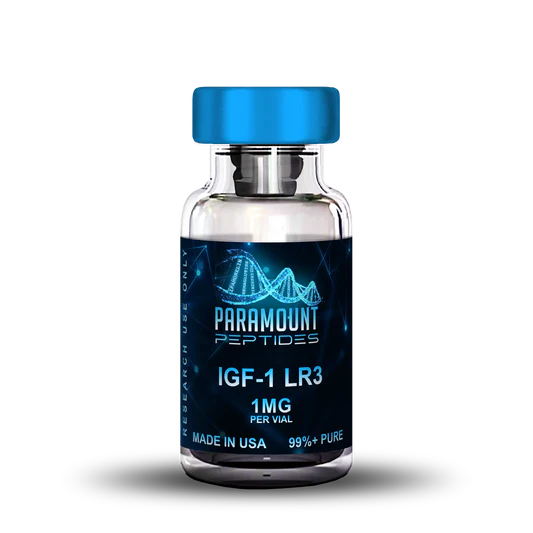
What is IGF-1 LR3 (1mg)?
IGF-1 LR3 , short for insulin-like growth factor-1 long arginine 3, is a synthetic modification of insulin-like growth factor-1 (IGF-1) designed for extended activity. This modified peptide exhibits a significantly longer half-life, up to 120 times more than standard IGF-1, owing to its reduced binding to IGF-1 binding proteins. Its prolonged presence in the bloodstream enhances its effectiveness. IGF1 LR3 plays a crucial role in promoting cell division, proliferation, and intercellular communication. Notably, it demonstrates improved performance in influencing fat metabolism, muscle repair, and hypertrophy by inhibiting myostatin. Recent studies suggest its potential utility in enhancing lactation among mothers with young offspring. The structural modifications of IGF1 LR3 involve the addition of 13 amino acids to the N-terminal end of IGF-1 and the conversion of the glutamic acid at position 3 to an arginine residue.
Chemical Structure of IGF-1 LR3 (1mg)
The chemical structure of IGF1 LR3 (insulin-like growth factor-1 long arginine 3) involves a modified form of the natural IGF-1 peptide. The modification includes the addition of 13 amino acids to the N-terminal end of IGF-1 and the conversion of the glutamic acid at position 3 to an arginine residue. This alteration enhances the peptide’s stability and prolongs its half-life by reducing its binding affinity to IGF binding proteins. The resulting structure allows IGF1 LR3 to remain active in the bloodstream for an extended period, up to 120 times longer than standard IGF-1.
The chemical sequence is:
Tyr-Gln-Pro-Pro-Ser-Thr-Asn-Lys-Asn-Thr-Lys-Ser-Gln-Arg-Arg-Lys-Gly-Ser-Thr-Phe-Glu-Glu-Arg-Lys-Cys-Arg.
What Are the Effects of IGF1 LR3 (1mg)?
IGF1 LR3 (insulin-like growth factor-1 long arginine 3) is a synthetic derivative of insulin-like growth factor-1 (IGF-1) with modified properties that enhance its physiological effects. The peptide, designed with an extended half-life, differs structurally from natural IGF-1. By not binding as strongly to IGF binding proteins, IGF1 LR3(1mg) remains active in the bloodstream for an extended duration, up to 120 times longer than standard IGF-1.
Cell Division and Growth
IGF1 LR3(1mg) is a potent stimulator of cell division and proliferation. It plays a crucial role in regulating the growth and development of various tissues, contributing to overall body growth.
Muscle Repair and Hypertrophy
One of the notable effects of IGF1 LR3(1mg) is its ability to enhance muscle repair and hypertrophy. It achieves this by inhibiting myostatin, a protein that acts as a negative regulator of muscle growth. By reducing the inhibitory influence of myostatin, IGF1 LR3(1mg) promotes muscle tissue repair and supports the development of larger muscle mass.
Fat Metabolism
IGF-1 LR3(1mg) is involved in the regulation of metabolism, particularly in boosting the metabolism of fats. This effect makes it of interest in the context of weight management and fat loss, as the peptide may enhance the breakdown and utilization of stored fat for energy.
Improved Lactation
Emerging research suggests a potential role for IGF-1 LR3(1mg) in improving lactation, especially among mothers with young offspring. The peptide’s influence on cellular processes may contribute to enhanced mammary gland function, supporting the production of milk.
Cell-to-Cell Communication
IGF1 LR3(1mg), like other IGF-1 derivatives, is involved in cell-to-cell communication. It plays a crucial role in signaling pathways that regulate cellular activities, including growth, differentiation, and survival.
While these effects highlight the diverse roles of IGF1 LR3(1mg), it’s important to note that the peptide’s use and research are ongoing, with continuous exploration of its potential applications in various fields, including sports science, endocrinology, and lactation research. As with any peptide, its administration and effects should be carefully studied and monitored for potential risks and benefits.


Reviews
There are no reviews yet.